Mobility & Disability · Buying Guide
Bariatric Scale Buying Guide: Format Before Capacity
A 1,000-pound platform scale is useless to a patient who cannot stand unassisted, and a wheelchair scale wastes money on a unit where patients transfer to a chair in under a minute. Match format to how patients move, then shop capacity.
Key takeaways
- Capacity is the second filter, not the first. Confirm whether the patient can stand, stays in a wheelchair, or needs a seated transfer before comparing weight limits.
- Three formats cover three transfer types: platform (standing), wheelchair or ramp (no transfer), and chair (seated transfer). Bedbound patients need a separate lift or sling scale.
- NTEP Class III legal for trade is the recognized accuracy benchmark separating facility-grade scales from consumer models, not a mandate to weigh patients on a certified scale.
- A refurbished scale can still carry Class III certification, but only if recalibration and a fresh Certificate of Conformance followed. Ask for documentation, not a verbal assurance.
Capacity Isn't the Decision, Mobility Is
Maximum weight capacity is the number on the spec sheet, but it is rarely the first question to ask. Most purchasing conversations start backward: a facility decides it needs a "bariatric scale," searches by capacity, and buys whichever model fits the budget, then discovers the format doesn't match how patients on the floor actually move.
The fix is simple: assess how patients move through the space first, then shop capacity within the format that fits. That's the difference between a scale used correctly and one that becomes a workaround.
Three Scale Formats, and the Patients Each One Actually Fits
Bariatric-capacity scales come in three main formats, part of the broader mobility and disability equipment category. Each format assumes a different physical capability.
Platform (floor) scales require the patient to stand unsupported long enough for the reading to settle. They give the most accurate standing weight and are the format most facilities already own, but are a poor fit if the patient cannot remain upright.
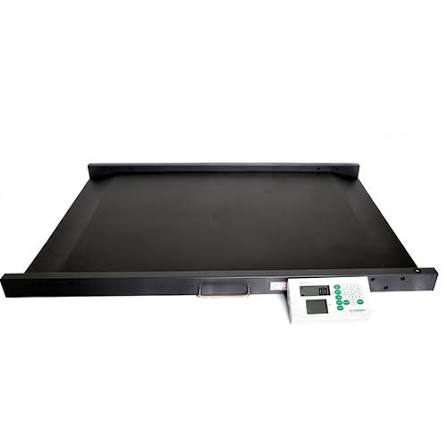
Wheelchair or ramp scales remove the transfer question: the patient rolls onto a low-angle ramp in their own chair, and the scale subtracts the chair's tare weight automatically. The tradeoff is footprint, more floor space and hallway clearance.
Chair (seated) scales sit in between: the patient transfers to a fixed seat, safer than standing but still requiring a supervised transfer. They are common in outpatient and dialysis settings, where a seated transfer is manageable but standing balance is not.
Each format breaks down at the edge of what it assumes: a platform scale when standing balance is unreliable, a chair scale when a seated transfer isn't safe. A wheelchair scale has no breakdown point for its population but is overbuilt for a unit that rarely sees one.
Format, mobility scenario, and capacity at a glance
| Format | Typical patient mobility / transfer scenario | Typical capacity range | NTEP Class III availability | Best-fit setting |
|---|---|---|---|---|
| Platform (floor) scale | Stands unassisted or with minimal support for the read | ~500–1,000+ lb | Widely available | General exam rooms, primary care, ambulatory bariatric patients |
| Wheelchair / ramp scale | Stays in wheelchair, rolls on via low-angle ramp, no transfer required | ~600–1,000 lb | Available; confirm per model | Emergency department, rehab, long-term care, high wheelchair volume |
| Chair (seated) scale | Can safely transfer to a seat but not stand or balance for a platform read | ~400–700 lb | Available; confirm per model | Outpatient clinics, dialysis, geriatric and bariatric seated populations |
Fully bedbound patients fall outside all three formats, weighed with a bed scale or overhead lift and sling scale built around a hoist rather than a platform, ramp, or seat.
Matching Format to How Your Patients Actually Transfer
Turning the format taxonomy above into a purchasing decision takes one honest assessment of your patient population, run before comparing capacity or price. Four transfer categories cover most facilities:
- Ambulatory: walks in, stands unsupported for a platform read. A standard platform scale sized to bariatric capacity is the right fit.
- Stands with assistance: bears weight and balances briefly with a rail, staff support, or a walker. Handrails on a platform scale work, but a chair scale removes the risk.
- Wheelchair-bound: does not transfer out of the wheelchair for routine care. A wheelchair or ramp scale is correct, not a platform scale plus a difficult transfer.
- Bed-to-chair lift transfer: moved with a mechanical or sling patient lift. A chair scale positioned to receive that transfer, or a dedicated lift/sling scale for a bedbound population, fits this group.
Run this assessment against actual patients, not an assumed average. A unit skewing wheelchair-bound and lift-transfer gets more real-world use from a wheelchair and chair scale than a second platform scale, even at lower capacity. Most facilities end up owning more than one format.
NTEP Class III Legal for Trade: The Real Facility-Grade Floor
Certification is the second half of this guide's premise. NTEP, the National Type Evaluation Program, evaluates devices against NIST Handbook 44. A scale marketed "NTEP Class III Certified Legal for Trade" has been independently evaluated against that standard.
Accuracy classes I, II, III, and IIII are defined in NIST Handbook 44; Class III is the designation most medical and physician scales carry. It is a construction standard, not a licensing requirement, and no source requires facilities to use it to weigh patients. Healthcare has adopted it as a voluntary but meaningful benchmark.
Why the accuracy floor matters in practice: inaccurate patient weight can drive weight-based medication dosing errors. A chart review at one urban academic medical center, published as a BMJ Quality Improvement Report and indexed on PubMed, found 13.8% of estimated weights on admitted emergency department patients varied by more than 10% from actual admission weight, with dosage errors traceable to those estimates. That is a single-center finding, not an industry-wide statistic, but a direct, peer-reviewed link between weight accuracy and dosing safety.
A related data point: a Pennsylvania Patient Safety Authority advisory found that 67.2% of reported weight errors, 322 of 479 events, actually reached the patient rather than being caught before administration. That reflects one state's reporting data, not a national estimate, but it supports prioritizing measured, accurate weights over estimation.
The certification itself, verified against Handbook 44 with a genuine Certificate of Conformance number, is what a buyer can actually check, not a marketing claim on a spec sheet.
A scale that never gets used correctly produces a chart entry that only looks like data. Format decides whether the scale gets used right; certification decides whether the number is one you can trust. iMedSales mobility equipment desk
New vs. Refurbished Bariatric Scales: Does the Certification Still Hold?
NTEP Class III certification is not permanently attached to a scale; it reflects the condition when evaluated. A refurbishment that opens the housing, replaces a load cell, or services internal components can affect accuracy, so certification needs re-verifying afterward, not assumed to carry over from the original sale.
Ask a refurbished-scale seller three things before treating certification as current: whether it was recalibrated, whether load-cell testing was performed, and whether a fresh Certificate of Conformance was reapplied. A seller who can document all three treats certification as an ongoing standard, the same standard that applies to refurbished medical equipment generally: paperwork matters more than the word "refurbished" on its own.
iMedSales sells both new and certified-refurbished bariatric scales, with a price-match guarantee and worldwide shipping, worth comparing using the documentation questions above.
Buyer Checklist: What to Verify Before You Order
Combine the format-matching framework, certification questions, and ordinary purchasing diligence, along the lines of general guidance on buying medical equipment for small clinics, into one checklist.
- Ask for the NTEP Certificate of Conformance number and Class III designation directly, not just a "legal for trade" label.
- Run the mobility and transfer assessment against your actual patient population before comparing capacity ratings.
- Confirm capacity exceeds your heaviest realistic patient by a safety margin, not the population average, the buffer Rehabmart's floor scale buying guide recommends for hospital, clinic, and home healthcare settings alike.
- For wheelchair models, confirm ramp angle and platform dimensions against your widest wheelchairs and hallway clearance.
- For refurbished units, confirm recalibration and re-verification happened after refurbishment, with documentation, not a general "tested and working" claim.
- Confirm the ongoing calibration interval, and who performs it: in-house biomed staff or a third-party provider.
- Check handrail, seatbelt or strap, and display readout height for patient safety and dignity during the weigh-in.
- Get warranty and parts or service availability in writing, and ask how location affects service response time for a repair visit.
Frequently asked questions
What weight capacity makes a scale "bariatric"?
There is no single regulatory cutoff. Scales marketed as bariatric generally start around 400 to 500 lb and range past 1,000 lb, versus a standard medical scale's typical 300 to 400 lb ceiling. The more useful question is whether a model's capacity clears your heaviest patient with a safety margin, which is why format and capacity are separate decisions.
What's the difference between a bariatric scale and a regular medical scale?
The core differences are capacity, platform size, and construction. Bariatric scales carry a higher-rated capacity, a wider and often lower platform or seat, and reinforced components like heavier-duty load cells and frames. A standard medical scale is built to a lower capacity standard throughout, not just a bariatric scale with a smaller number on the display.
How do you weigh a bariatric patient who can't stand on a platform scale?
Use a format that does not require standing balance. A wheelchair or ramp scale weighs the patient in their own chair, no transfer needed. A chair scale works if the patient can safely complete a seated transfer. For a bedbound patient, a bed scale or lift and sling scale is right.
What does NTEP Class III certification mean, and do medical facilities actually need it?
NTEP Class III certification means a scale has been independently evaluated against NIST Handbook 44's accuracy and construction requirements, the class used for general medical and physician scales. It is not a licensing requirement; "legal for trade" is a commerce-law term for goods bought and sold by weight. Facilities aren't legally mandated to use a Class III scale, but healthcare has adopted it as the benchmark separating facility-grade scales from consumer models, and given the link to dosing safety, it's worth insisting on.
How often do bariatric and other medical scales need to be calibrated?
Intervals vary by manufacturer, usage volume, and facility policy, so confirm the interval with the seller rather than assuming an industry-wide number. High-use scales, and any scale just moved, dropped, or refurbished, warrant more frequent verification than a low-volume unit in a stable location. Build the interval into your purchasing decision.
Sources
- National Institute of Standards and Technology. NIST Handbook 44 (2026 edition): Specifications, Tolerances, and Other Technical Requirements for Weighing and Measuring Devices. Accessed August 2026.
- Greenwalt M, Griffen D, Wilkerson J. Elimination of Emergency Department Medication Errors Due To Estimated Weights. BMJ Quality Improvement Reports, PMID 28469895. Accessed August 2026.
- Rehabmart. How to Choose the Best Floor Scale for Hospitals, Clinics, and Home Healthcare. Accessed August 2026.
- Pennsylvania Patient Safety Authority. Medication Errors: Significance of Accurate Patient Weights. Accessed August 2026.