Quick answer: Basic surgical instruments are organized by function into a few core families: cutting and dissecting (scalpels, scissors), clamping and occluding (hemostats, clamps), grasping and holding (forceps), retracting and exposing (retractors), and suturing (needle holders, needles, sutures), plus suction. Each family has a handful of named instruments, like the Mayo and Metzenbaum scissors, Adson and DeBakey forceps, Kelly and mosquito hemostats, and Army-Navy and Deaver retractors, that recur across nearly every procedure.
Surgical instruments look bewildering as a tray of similar-looking steel, but they become straightforward once you see the organizing logic: nearly every instrument exists to perform one of a few actions, and instruments that share an action share a family resemblance. Authoritative surgical references consistently group the basics into the same functional categories, used for cutting, dissecting, suturing, suctioning, clamping, grasping, holding, retracting, and viewing. Learn the categories first, then the named instruments within each, and identification clicks into place. This is a visual reference organized that way.
Correct identification is not academic. It ensures patient safety, prevents misuse during procedures, and improves communication and efficiency within the surgical team. Whether you are a student, a new OR staff member, or a buyer learning the catalog, the framework below is the foundation.
The functional families
- Cutting & dissecting: scalpels, scissors, rongeurs
- Clamping & occluding: hemostats and clamps
- Grasping & holding: forceps
- Retracting & exposing: retractors
- Suturing: needle holders, needles, sutures
- Suction & aspiration: suction tips
1. Cutting and Dissecting Instruments
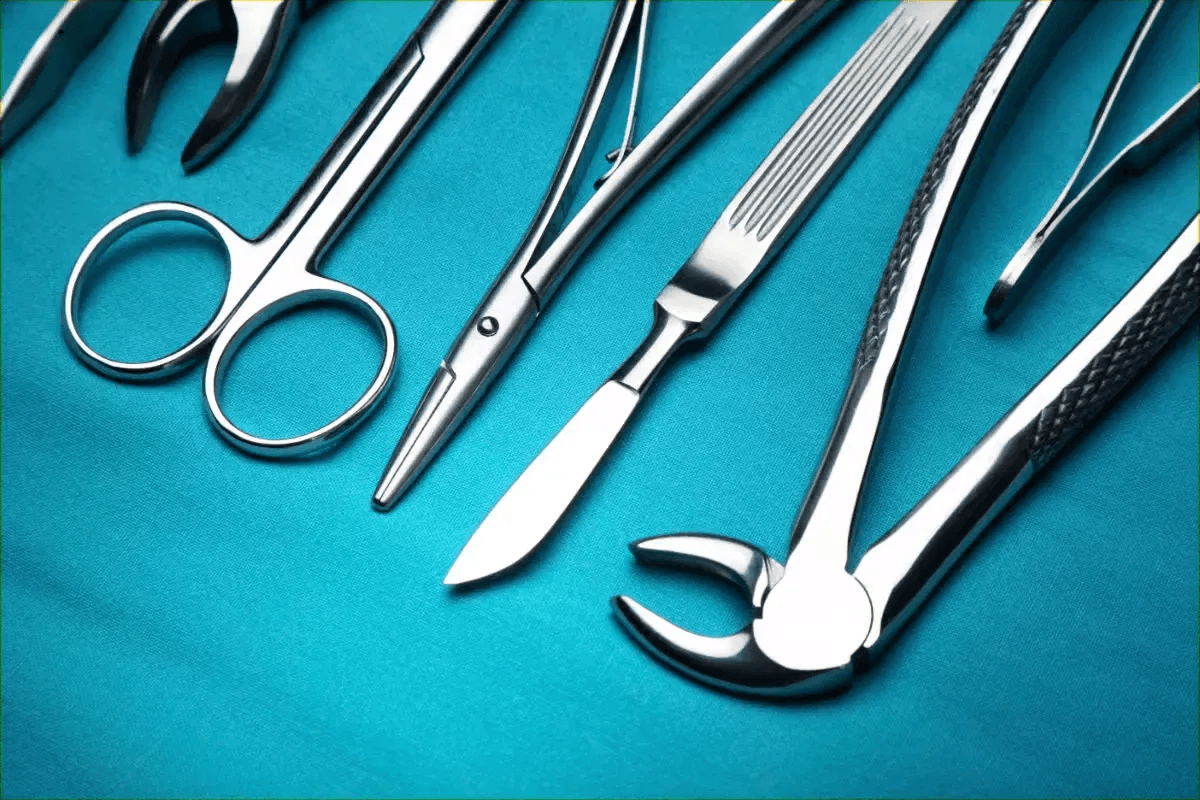
These instruments incise and divide tissue. The defining visual is a blade or sharp edge.
- Scalpel (knife handle + blade): the primary cutting tool, a handle holding a replaceable blade. Blade numbers signal use: a No. 10 blade for smaller incisions in skin and tissue, a No. 15 for fine work, a No. 11 for stab incisions. Handles are commonly numbered too (a No. 3 handle for most blades, a No. 7 for deeper, delicate work).
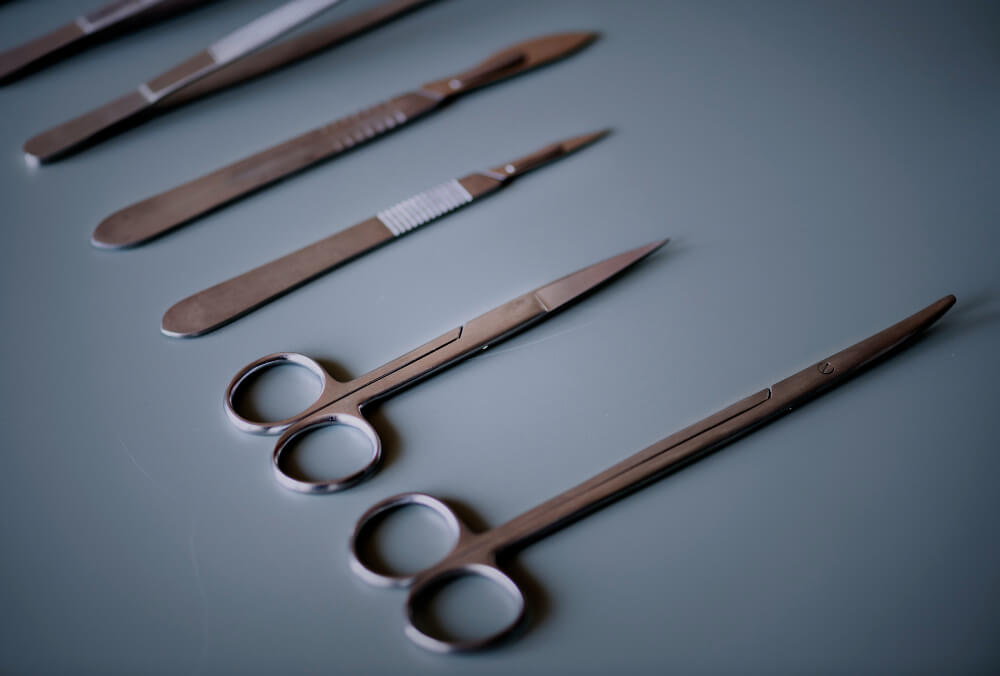
- Mayo scissors: heavy scissors with semi-blunt tips, used to cut thick tissues or sutures, available straight (for suture) or curved (for tissue).
- Metzenbaum scissors: lighter, with delicate tips, used for dissecting and cutting delicate tissues. The quick rule: Mayos for tough tissue and suture, Metzenbaums for fine dissection.
- Iris scissors: small, sharp scissors for precise cuts in delicate work such as ophthalmic procedures.
- Rongeurs: heavy instruments for cutting or removing bone.
2. Clamping and Occluding Instruments
These instruments compress vessels or tissue, most often to control bleeding. The defining visual is a ratchet at the finger rings that locks the jaws closed. They are used for clamping blood vessels and other tissue to keep them out of the field.
- Hemostatic forceps (hemostats): the workhorse clamps for controlling bleeding.
- Mosquito forceps: small, fine hemostats for clamping small vessels.
- Kelly forceps: larger hemostats for clamping blood vessels to control bleeding.
- Spencer Wells forceps: straight or curved, used to clamp medium to large vessels prior to ligation.
- Bulldog clamp: a small spring clamp for occluding small vessels with minimal trauma.
The visual progression from tiny mosquito to larger Kelly mirrors the size of what they clamp.
3. Grasping and Holding Instruments
These instruments hold and manipulate tissue so the surgeon can see and work. Most are forceps, and the key visual distinction is the tip: toothed (interlocking teeth for a firm grip on tough tissue like skin) versus non-toothed/smooth (atraumatic, for delicate tissue).
- Tissue forceps: two arms meeting at a hinge; come in toothed and non-toothed types so surgeons can match grip to tissue.
- Adson forceps: fine forceps for grasping delicate tissues or sutures.
- DeBakey forceps: non-toothed, atraumatic forceps used widely, notably to grasp tissues such as bowel without damaging them.
- Allis forceps: ratcheted forceps with small teeth for grasping and holding tissue firmly.
- Babcock forceps: atraumatic, used to grasp delicate structures such as intestine.
- Rat-tooth and Gillies forceps: toothed forceps, commonly used to grasp skin (not to be used on bowel).
The clinical rule embedded here: toothed forceps for skin and tough tissue, atraumatic forceps like DeBakey and Babcock for delicate structures and bowel.
4. Retracting and Exposing Instruments
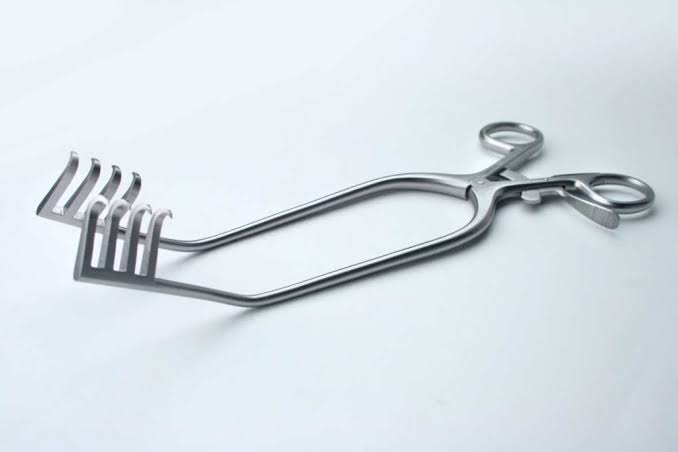
Retractors hold tissues and organs aside to improve visibility and access to the surgical field, reducing accidental injury and enhancing precision. The key visual distinction is handheld (an assistant holds it) versus self-retaining (it locks open by itself, freeing hands).
- Army-Navy retractor: a common double-ended handheld retractor for shallow to moderate-depth retraction.
- Deaver retractor: a large, curved handheld retractor for deep abdominal retraction.
- Richardson retractor: a right-angled handheld retractor for abdominal walls.
- Weitlaner and Gelpi retractors: self-retaining retractors that hold themselves open for hands-free exposure.
- Langenbeck retractor: a versatile handheld retractor used across many specialties.
Self-retaining retractors are ideal for hands-free operation, while handheld types give an assistant dynamic control of the exposure.
5. Suturing Instruments
These instruments close tissue. A basic suturing set contains a needle, a needle holder, and pairs of fine-toothed forceps and scissors.
- Needle holder (needle driver): a ratcheted instrument that grips the curved needle for suturing. Fine versions like the Castroviejo are used for delicate work.
- Surgical needles: come in many shapes and sizes to suit different tissues and stitching applications.
- Sutures: the thread that holds tissue together after closure.
- Alternatives: staplers and skin glues are common options for skin closure.
6. Suction and Aspiration
Suction instruments clear blood and fluid from the field to maintain visibility. The most familiar basic example is the Frazier suction tip, a fine suction tube used in delicate and neurological work, alongside larger tips like the Yankauer for general suction.
The "54 Basic Surgical Instruments"
You will often see reference to a set of 54 basic surgical instruments, a standard teaching list that catalogs the common instruments across all the categories above, from knife handles and Mayo scissors to Kelly clamps, Adson forceps, and Richardson retractors. It is a useful study reference, but the number is less important than the framework: once you know the six functional families and the signature instruments in each, you can place almost any instrument you encounter.
How to Use This Reference
When you pick up an unfamiliar instrument, ask one question: what action does it perform? A blade cuts, a ratcheted clamp occludes, a forceps grasps, a retractor exposes, a needle holder sutures. That single question places it in a family, and the family narrows the possibilities to a handful of named tools you can then distinguish by their visual signatures, toothed versus smooth, heavy versus delicate, handheld versus self-retaining. Master the families and the individual instruments stop being a memorization exercise and become a logical system.
Frequently Asked Questions
What are the main categories of surgical instruments?
Surgical instruments are grouped by function into cutting and dissecting (scalpels, scissors), clamping and occluding (hemostats, clamps), grasping and holding (forceps), retracting and exposing (retractors), and suturing (needle holders, needles, sutures), with suction and aspiration as an additional group. Each category corresponds to a specific action performed during surgery, which is the key to identifying any instrument.
What is the difference between Mayo and Metzenbaum scissors?
Mayo scissors are heavier with semi-blunt tips, used for cutting thick tissue and sutures, and come straight (for suture) or curved (for tissue). Metzenbaum scissors are lighter with delicate tips, used for fine dissection and cutting delicate tissue. The simple rule is Mayos for tough tissue and suture, Metzenbaums for delicate dissection.
What is the difference between toothed and non-toothed forceps?
Toothed forceps have interlocking teeth at the tip for a firm grip on tough tissue like skin, while non-toothed (smooth) forceps are atraumatic and used on delicate tissue. For example, rat-tooth and Gillies forceps grasp skin, while DeBakey and Babcock forceps are atraumatic and used on delicate structures such as bowel. Matching the forceps to the tissue prevents damage.
What is the difference between handheld and self-retaining retractors?
Handheld retractors, such as Army-Navy and Deaver, must be held in place by an assistant, giving dynamic control of the exposure. Self-retaining retractors, such as Weitlaner and Gelpi, lock open by themselves to hold tissue aside hands-free. Both improve visibility and access to the surgical field; the choice depends on whether hands-free operation or dynamic adjustment is needed.
What are the 54 basic surgical instruments?
The "54 basic surgical instruments" is a standard teaching list cataloging common instruments across all the functional categories, including knife handles, Mayo and Metzenbaum scissors, Kelly and mosquito hemostats, Adson and Allis forceps, and Army-Navy and Richardson retractors. It is a useful study reference, though the underlying framework of functional families matters more than the specific count.