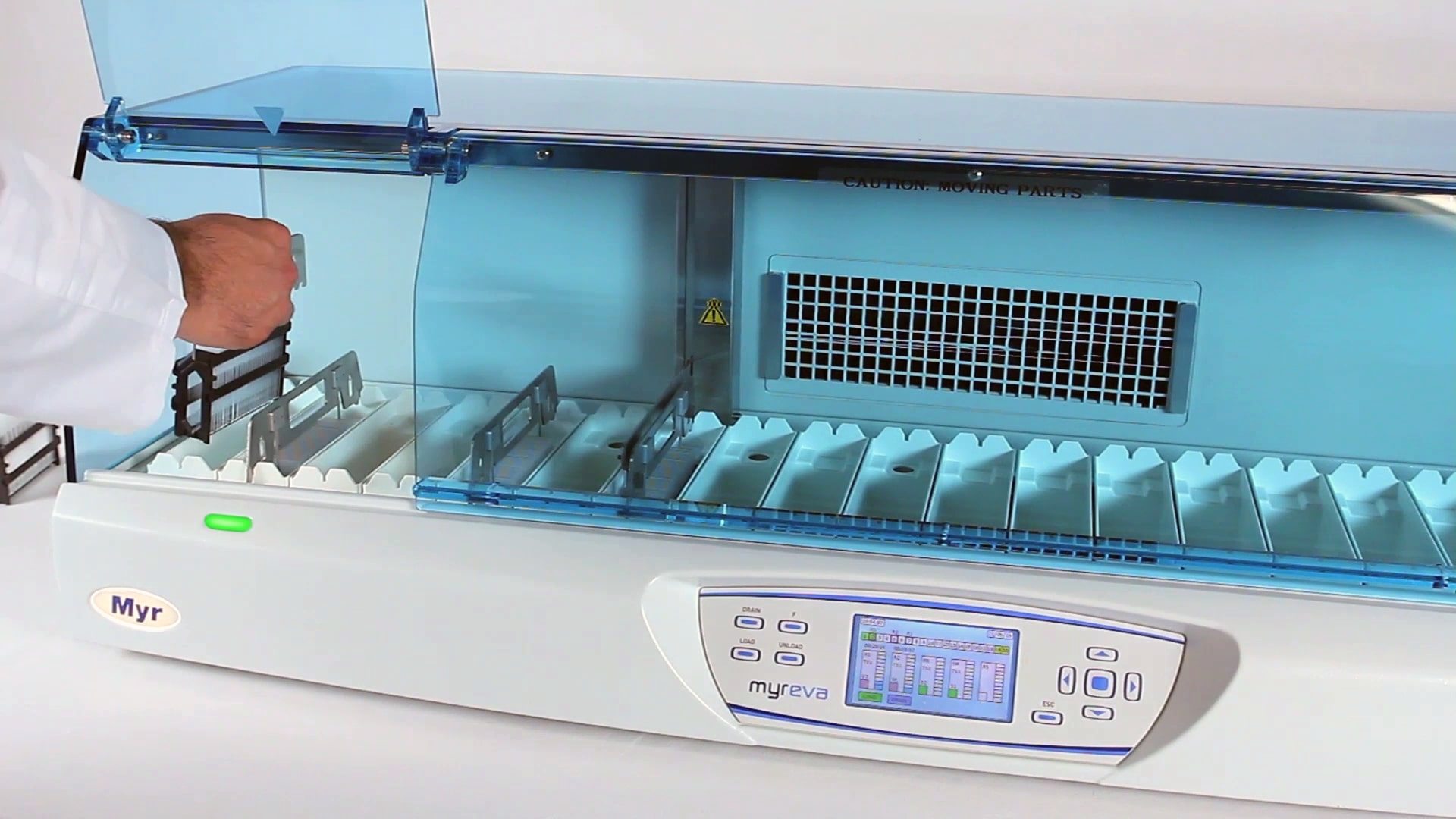
An automated stainer is usually sold on speed. Speed is not the reason to buy one. The reason is that a pathologist reads color, and color that drifts from one batch to the next is a diagnostic problem, not a cosmetic one. The right stainer makes every slide look like the last one and keeps the xylene out of the room while it does it. Buy for consistency and containment first.
An automated slide stainer moves tissue sections through a programmed sequence of reagents to stain them for microscopic diagnosis. The FDA defines it plainly: a device used to stain histology, cytology, and hematology slides for diagnosis, regulated as a Class I device under 21 CFR 864.3800. In a histology lab it is the step after sectioning and before the microscope, the instrument that turns a colorless section into the pink-and-blue image a pathologist actually reads.
This guide is vendor-neutral. It covers when you need one, what the instrument standardizes, the linear-versus-batch decision, the specs and features that change the choice, why solvent safety belongs on the spec sheet, and what to verify before buying refurbished. Where manual staining or buying new is the better call, it says so.
The one question that decides whether you need one
Before comparing models, answer this: how many slides do you stain a day, and how consistent do they have to be? A low-volume lab staining a handful of slides can do excellent work by hand. Once volume rises, or once consistency between runs becomes a diagnostic and accreditation issue, manual staining becomes the bottleneck and the variable. Automation earns its place by removing the drift, not by going fast.
Then narrow by what you stain. Most labs need routine hematoxylin and eosin, the H&E that is the workhorse of diagnostic pathology. Some also run special stains, the histochemical stains that highlight specific structures or organisms. A third category, immunohistochemistry, uses antibodies and is a different instrument class, an immunostainer, not the H&E and special-stain device this guide covers. Buying an H&E stainer when you need IHC, or the reverse, is a mismatch no spec sheet fixes.
The instrument also does not stand alone. It is the third step in a chain: tissue is processed and embedded, sectioned on a microtome or, for frozen work, a cryostat, then stained. If sectioning is your constraint, the fix is upstream, in our microtome buying guide and tissue processor buying guide, not in a faster stainer.
What an automated stainer actually standardizes
To judge a stainer you have to know what it controls. The H&E method is a sequence, and each step has to land the same way every time. Hematoxylin is a basic dye that stains acidic structures such as the DNA in cell nuclei a purple-blue; eosin is an acidic counterstain that turns basic structures such as cytoplasm pink-red, so the pathologist can read nuclear and cytoplasmic detail and the overall tissue architecture, as described in the NIH StatPearls reference on histology staining.
Between those two dyes sit the steps that actually decide quality and that automation exists to standardize: deparaffinizing the section, running it down through graded alcohols to water, the hematoxylin stain, a differentiation step in weak acid to strip excess stain, a bluing step in mildly alkaline water, the eosin counterstain, and dehydration back up through alcohols and a clearing solvent before coverslipping. Each is a timed immersion. Done by hand, the times and the reagent freshness vary with the technologist and the day. Done by machine, they repeat. That repeatability is the product you are buying, and it is what keeps a slide readable and comparable across a run and across a year.
Linear and batch stainers, and matching one to your lab
Automated stainers come in two broad designs, and the difference is workflow, not quality.
Linear, or continuous, stainers. Slides move one rack after another through a fixed line of reagent stations on a conveyor, so new racks can be loaded continuously without waiting for the last batch to finish. This suits high-volume labs with a steady stream of H&E, because throughput is sustained and uninterrupted. The tradeoff is less flexibility: the line runs one protocol at a time, and changing it interrupts the flow.
Batch, or dip-and-dwell, stainers. A robotic arm carries a basket of slides through programmed stations, dwelling at each for a set time. Batch units are more flexible, handling multiple protocols and special stains with different timings, which fits labs with a varied workload or a mix of H&E and specials. The tradeoff is that a batch finishes before the next begins, so peak throughput is lower than a continuous line.
Dedicated special-stain stainers. Some instruments are built specifically for the histochemical special stains, automating protocols that are otherwise labor-intensive and variable by hand. If special stains are a meaningful part of your volume, a dedicated or capable batch unit is worth costing out against the labor it replaces. Match the architecture to your real mix: heavy, steady H&E points to linear; a varied or special-stain-heavy workload points to batch.
The specs and features that change the decision
Once the design is settled, a handful of specs separate a stainer that fits from one that fights you.
Throughput. Rated in slides per hour, but read it against your peak day, not your average. A continuous line and a batch unit with the same nominal rate behave differently under a morning surge, so match sustained throughput to your real workflow.
Programmable protocols. Confirm the instrument stores the protocols you run, with the step times and reagent assignments you need, and that switching protocols is workable for your mix. A lab running only H&E needs less flexibility than one juggling specials.
Reagent management. Look at vessel capacity, how reagents are filled and exchanged, and whether the unit tracks reagent use or aging. Stain quality drifts as reagents tire, so management features protect consistency and control reagent cost.
Coverslipper integration. The step after staining is coverslipping. Some stainers integrate with or connect to an automated coverslipper, which removes a manual handoff and reduces solvent exposure at the bench. If volume is high, this integration is worth pricing.
Footprint, ventilation, and consumables. Confirm the unit fits the bench and, critically, the ventilation it needs, covered next. Check whether it uses proprietary reagent containers or open vessels, because consumable format affects both cost and supply.
Solvent safety is part of the spec, not an afterthought
An H&E line runs on alcohols and a clearing solvent, usually xylene, and the sections arriving from processing carry formaldehyde history. Those reagents are hazardous, and the staining bench is a recognized source of exposure. Formaldehyde is regulated by OSHA, and the StatPearls summary of the OSHA formaldehyde standard sets the permissible exposure limit at 0.75 parts per million as an 8-hour time-weighted average, with the standard applying squarely to histology and pathology laboratories. Xylene and the alcohols add their own inhalation and flammability hazards.
This is a reason automation helps rather than a reason to avoid it. A closed or vented instrument with managed reagent handling reduces the open solvent surface and the manual transfers that drive exposure, and pairing the stainer with an automated coverslipper cuts the most solvent-heavy manual step. What it means for the purchase is concrete: confirm the unit's ventilation or fume-extraction requirements and that your bench can meet them, favor designs that keep solvent vessels covered, and plan reagent filling and disposal as part of the workflow rather than an afterthought. For the broader engineering-control picture in tissue work, our biosafety cabinet buying guide covers the containment side.
Buying refurbished, and when new is the better call
Automated stainers are durable mechanical instruments, and a professionally refurbished unit can be a sound buy at a meaningful discount. The wear lives in predictable places: the transport arm or conveyor that moves slides, the pumps and valves that handle reagents, the heating and drying stations, and the software that runs the protocols. So refurbished here means those were inspected and serviced, not just that the machine powers on.
The distinction that matters is refurbished versus merely used. Refurbished means the transport mechanism has been tested, pumps and valves serviced, the unit run through a full staining cycle to confirm it completes protocols correctly, and the software verified, with a written report. Used often means cleaned and listed. Ask for specifics: Does the transport move reliably through a full run without stalling? Have the reagent pumps and valves been serviced and checked for leaks? Does it complete a stored protocol and produce an acceptable stain on a test run? Are the racks, baskets, and reagent vessels included, and are consumables still available? What return window and coverage come with it? A reputable seller answers plainly. Walk away from anyone who cannot.
There are cases where new is the better call. If you need a current software platform with an audit trail for accreditation, a specific proprietary reagent ecosystem, or integrated coverslipping with no sound refurbished supply, buy new. Honest sellers say so rather than pushing inventory. The same vendor-neutral logic applies to any used instrument, and our guide to vetting a refurbished equipment supplier lays out the questions in full.
One regulatory note worth getting right. The automated slide stainer is an FDA Class I device under 21 CFR 864.3800 and is exempt from premarket notification subject to the limits in that part. That low regulatory burden is normal for general pathology instruments. It does not replace your own verification that a given unit completes its protocols and produces a consistent stain.
A short pre-purchase checklist
Before you commit, confirm the following. Your slide volume and consistency needs actually justify automation over careful manual staining. The stain type matches the instrument, meaning an H&E and special-stain device for routine histology, not an immunostainer, which is a separate class. The design fits your workflow, with linear or continuous for heavy steady H&E and batch for a varied or special-stain workload. The rated throughput holds against your peak day, not your average. The protocol programming and reagent management suit your mix, and coverslipper integration is considered if volume is high. The ventilation or fume-extraction requirement is met by your bench, and solvent vessels stay covered. For refurbished, you have a written service report, a confirmed test-run stain, and assurance that racks, vessels, and consumables are available. And the seller has been straight about when buying new is the better option.
iMedSales sells new and professionally refurbished automated slide stainers and other histology equipment worldwide, with a price-match guarantee and a 30-day return window. It is one honest option among reputable peers, and the right choice is whichever vendor answers the questions above without flinching. Questions on a specific unit can go to (855) 200-0633. For the neighboring steps on the bench, our cryostat buying guide and guide to types of medical microscopes follow the same approach.
Frequently asked questions
What is an automated slide stainer used for?
It moves tissue sections on slides through a programmed sequence of reagents to stain them for microscopic diagnosis. The FDA describes it as a device used to stain histology, cytology, and hematology slides for diagnosis, regulated as Class I under 21 CFR 864.3800. In a histology lab it is the step between sectioning and the microscope, turning a colorless section into the stained image a pathologist reads.
What is the difference between a linear and a batch slide stainer?
A linear or continuous stainer moves slide racks one after another through a fixed line of reagent stations, allowing continuous loading and high sustained throughput for steady H&E work. A batch or dip-and-dwell stainer uses a robotic arm to carry a basket through stations for set times, which is more flexible for multiple protocols and special stains but finishes one batch before starting the next. Heavy steady H&E favors linear; a varied workload favors batch.
Does an automated stainer do immunohistochemistry?
No. Routine automated slide stainers handle hematoxylin and eosin and histochemical special stains. Immunohistochemistry, which uses antibodies to detect specific antigens, is performed on a separate instrument class called an immunostainer. If you need IHC, buy for that workflow specifically rather than expecting an H&E and special-stain device to cover it.
What are the safety concerns with an automated stainer?
An H&E line uses alcohols and a clearing solvent, usually xylene, and the sections carry formaldehyde history, all of which are hazardous. Formaldehyde is OSHA-regulated, and the StatPearls summary of the OSHA formaldehyde standard sets a permissible exposure limit of 0.75 parts per million as an 8-hour time-weighted average, with the standard applying to histology and pathology labs. Confirm the instrument's ventilation requirements, favor covered solvent vessels, and consider an integrated coverslipper to cut manual solvent handling.
Is it safe to buy a refurbished slide stainer?
Yes, when it is genuinely refurbished rather than just used. The wear is predictable, in the transport mechanism, the reagent pumps and valves, the heating stations, and the software, so a sound refurbishment tests those, runs a full cycle to confirm it completes protocols, and verifies an acceptable stain on a test run, with a written report. Ask for that report, confirmation that racks, vessels, and consumables are available, and a clear return window.