We deliver goods to any city in the world!
A price match guarantee for best prices on all our products


Alcohol Prep Pads: Sizes, Sterile vs Non-Sterile, Buying Guide
- June 23, 2026
- 11 min read
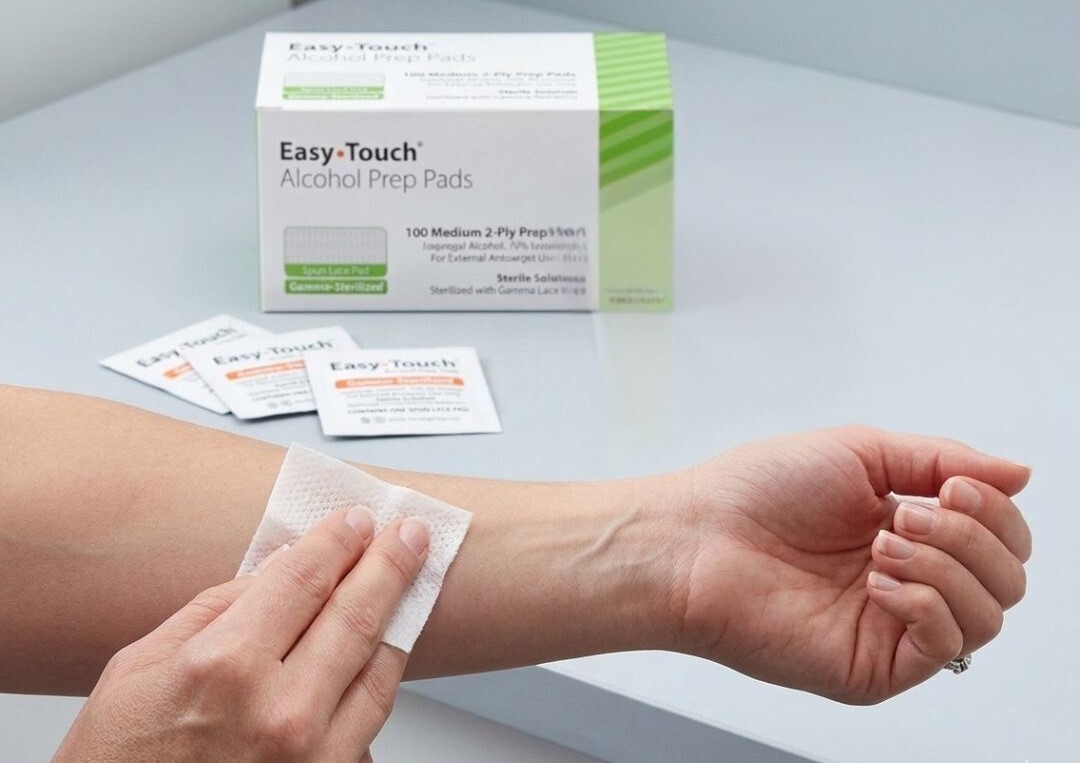
Alcohol prep pads are the cheapest item on the supply shelf, so most buyers grab whatever box is in stock. That works until it does not. The spec details on these small foil packets actually matter: the alcohol concentration changes how well they kill microbes, the sterile-versus-non-sterile label dictates where you can use them, and for a handful of procedures an alcohol pad is simply the wrong product. This guide walks through what to look for, how to use a pad correctly, and the cases where you need to step up to chlorhexidine or povidone-iodine instead.
What an alcohol prep pad is, and what it does
An alcohol prep pad is a small nonwoven wipe saturated with isopropyl alcohol (usually 70%) and sealed in a single-use foil packet. Its job is antisepsis: reducing the number of bacteria on intact skin before an injection, a finger stick, or a venipuncture. Alcohol works by denaturing the proteins inside microbial cells. It is fast, inexpensive, and effective against a broad range of common skin bacteria when used correctly.
It is not a cleaner for visibly dirty skin, and it is not a substitute for hand hygiene. The WHO injection-safety toolkit is explicit that alcohol skin disinfection is a step within an aseptic process, applied to a single-use swab, not a stand-alone shortcut. See the WHO guidance on skin preparation and disinfection for injections.
Why 70% isopropyl alcohol is the right concentration
Buyers often assume a higher alcohol percentage kills more. The opposite is true for antisepsis. The standard preparation, 70% isopropyl alcohol pads, outperforms 90% or 99% for killing microbes on skin, and the reason is water content.
Water is not filler here. It slows evaporation, giving the alcohol more contact time, and it helps the alcohol penetrate the cell wall so proteins coagulate throughout the cell rather than just at the surface. At very high concentrations the alcohol denatures the outer proteins so fast that it forms a hardened shell, which actually shields the interior of the microbe. The CDC puts the optimum bactericidal range at 60% to 90% alcohol in water; see the CDC's guidance on chemical disinfectants, including alcohol. The WHO toolkit similarly specifies a 60% to 70% alcohol-based solution for skin disinfection and warns against methanol, which is unsafe for human use.
Practical takeaway: when you read the box, look for "70% isopropyl alcohol" (or "isopropanol"). A 91% or 99% pad is not an upgrade for skin antisepsis. Those higher grades are better suited to drying electronics or dissolving residues, not prepping a patient.
Sterile vs non-sterile alcohol prep pads
This is the distinction most buyers overlook, and it is a real one. "Non-sterile" does not mean dirty. As the FDA explains, a non-sterile label means the product's contents were not put through a manufacturing process that eliminates all potential microorganisms; a sterile product was. OTC antiseptics for preinjection and preoperative skin prep are not required to be manufactured as sterile, so many common pads are non-sterile by default. See the FDA's questions and answers on sterile versus non-sterile topical antiseptics.
Why it matters: alcohol does not reliably kill bacterial spores, and a small number of contaminated-product outbreaks have been traced to non-sterile pads. In a 2010 Colorado investigation, a child with leukemia developed sepsis after a vascular access device was placed, and hospital testing found Bacillus cereus or related Bacillus species in 40 of 60 non-sterile alcohol pads sampled. The hospital switched to sterile pads exclusively, and the manufacturer later recalled all of its alcohol wipe products. The CDC documented the episode in its report on contamination of alcohol prep pads with Bacillus species.
The buying rule that follows from this: for routine injections, finger sticks, and most venipuncture on intact skin, non-sterile pads are widely used and accepted. For higher-risk situations, choose sterile. The FDA advises that non-sterile products should not be used to prep patients prior to surgery, for catheter insertion, or on immunocompromised patients.
| Factor | Non-sterile pads | Sterile pads |
|---|---|---|
| Manufacturing | Not processed to eliminate all microorganisms | Processed and validated to be free of viable microorganisms |
| Typical use | Routine IM/SC injections, finger sticks, routine venipuncture on intact skin | Procedures requiring strict asepsis; immunocompromised patients |
| Cost per pad | Lowest | Higher |
| Best for buyers who | Stock high volume for general clinic and home use | Prep central lines, surgical-adjacent steps, or vulnerable patients |
Sizes and ply: matching the pad to the job
"Alcohol prep pad sizes" is a real search because the small packets vary more than people expect. The common dimensions you will see on a spec sheet are the unfolded pad size, often around 2.0 by 2.4 inches for a standard pad and roughly 1.0 by 2.6 inches for the small or "sterile" size, plus the ply (the number of folded layers).
- Standard pads give more surface area for a wider field, such as prepping a larger venipuncture site.
- Small pads are economical for finger sticks and tight, single-point preps.
- 2-ply versus thicker pads: more ply holds more alcohol and resists tearing during friction. A thin, single-ply pad can dry out faster and shred mid-scrub.
For high-volume sites, do the simple math: a busy phlebotomy desk or a vaccination clinic burns through pads quickly, so a slightly larger or higher-ply pad that does the job in one pass can be more economical than a cheaper pad that needs two. If you are also reviewing your wound-care stock, our guide to the types of gauze and when to use each covers the same buy-by-the-job logic for dressings.
How to use an alcohol prep pad correctly
Most of the value of a pad is in the technique, and most of the failures come from rushing it. Two steps decide whether the prep actually works: friction and dry time.
- Friction. Wipe with firm pressure in a single direction, working from the center of the site outward, without going back over the same area. The WHO toolkit describes this center-out motion as the standard for injection skin prep.
- Contact and dry time. Apply the alcohol for about 30 seconds, then let the site air dry completely. Drying is not optional. The antiseptic action continues as the alcohol evaporates, and injecting through a wet site is both less effective and more likely to sting. The WHO guidance specifies applying the solution for 30 seconds and allowing it to dry.
Two more points worth knowing. First, for routine immunizations, alcohol skin prep is generally not required, and the WHO toolkit explicitly says not to use alcohol disinfection for the administration of vaccinations, in part because routine vaccination of clean skin does not need it. Follow your facility protocol. Second, never pre-soak a stack of gauze or cotton in an open container of alcohol as a money-saver; the WHO toolkit warns these become heavily contaminated with hand and environmental bacteria. Single-use packets exist for a reason.
When an alcohol prep pad is not enough
This is the part buyers skip, and it is where the wrong product choice can cause real harm. Alcohol alone is fine for routine skin antisepsis, but for several higher-risk procedures the standard of care is an antiseptic with persistent activity, usually chlorhexidine gluconate (CHG) in alcohol, or povidone-iodine.
- Surgical sites. A landmark randomized trial found chlorhexidine-alcohol significantly more protective than povidone-iodine against surgical-site infection after clean-contaminated surgery, including lower rates of superficial and deep incisional infection. See the New England Journal of Medicine study on chlorhexidine-alcohol versus povidone-iodine for surgical-site antisepsis.
- Central lines and vascular catheters. CDC guidelines recommend preparing clean skin with a greater-than-0.5% chlorhexidine preparation with alcohol before central venous catheter and peripheral arterial catheter insertion. See the CDC's guidelines for the prevention of intravascular catheter-related infections.
- Blood cultures. Skin antisepsis for blood culture collection commonly uses a chlorhexidine-alcohol or iodine-based prep rather than alcohol alone, and combination kits are associated with low contamination rates. See the study on skin antisepsis kits and blood culture contamination.
The reason these cases differ is persistence. Alcohol kills fast but evaporates and leaves no residual activity, while chlorhexidine keeps working on the skin for hours. For a deeper look at building and protecting an aseptic field, see our guide to maintaining a sterile field. Glove choice is part of the same chain; our sterile versus non-sterile gloves comparison and broader medical gloves guide walk through when each is appropriate.
Shelf life, drying out, and storage
Alcohol prep pads carry an expiration date, and it is meaningful. Over time, alcohol evaporates through any imperfect seal, and a dried-out pad does not deliver the concentration or contact time it should. Check the lot expiration on the box, rotate stock so older boxes are used first, and discard pads whose packets feel dry or look swollen or damaged.
The FDA's broader guidance on these products reinforces a few storage habits: do not dilute the product, do not use it past its expiration date, and do not use pads that have been sitting exposed in open containers. Keep boxes sealed, cool, and away from heat sources, since alcohol is flammable. These are the same handling principles you would apply to the contents of a stocked dressing change kit.
How to buy by the case
Because pads are inexpensive and used in volume, the smart purchase is by the case, with attention to a short checklist rather than price alone:
- Concentration: confirm 70% isopropyl alcohol for skin antisepsis.
- Sterile or non-sterile: match the label to your highest-risk use, and clearly separate sterile stock if you keep both.
- Size and ply: pick the size that finishes the prep in one pass for your most common task.
- Packaging: single-use foil packets with intact seals, as the FDA recommends single-use containers for these products.
- Expiration and lot: buy quantities you will use before the date, and keep lot numbers for traceability.
iMedSales stocks single-use antiseptic supplies among many other new and refurbished medical products, with a price-match guarantee and a 30-day return policy. We are one honest option among reputable suppliers; buy on spec, not on the logo. Questions on a bulk order can go to (855) 200-0633.
Frequently Asked Questions
Are alcohol prep pads sterile?
Some are and some are not. Non-sterile pads are common and acceptable for routine injections and finger sticks on intact skin. Sterile pads are processed to remove viable microorganisms and are the right choice for higher-risk uses such as catheter insertion, surgical prep, or immunocompromised patients. The FDA notes that OTC antiseptic prep products are not required to be manufactured as sterile, so always check the label.
Why is 70% isopropyl alcohol better than 90% or 99%?
The water in a 70% solution slows evaporation and helps the alcohol penetrate microbial cells, so proteins coagulate throughout the cell instead of just forming a protective shell at the surface. The CDC puts the optimum bactericidal range at 60% to 90% alcohol in water, and activity drops sharply when diluted below 50%. For skin antisepsis, a 70% pad is the standard, not the budget option.
Do I need an alcohol wipe before every injection?
For most injections on visibly clean, intact skin, an alcohol wipe used with friction and full dry time is standard practice. For routine vaccinations, the WHO injection-safety toolkit states that alcohol skin disinfection is not used. Always follow your facility's protocol and the product instructions.
When is an alcohol pad not enough?
For surgical sites, central lines and other vascular catheters, and blood culture collection, alcohol alone is generally not sufficient. These situations call for an antiseptic with persistent activity, typically chlorhexidine gluconate in alcohol or povidone-iodine, because alcohol evaporates and leaves no residual protection.
How long do alcohol prep pads last?
Use them before the printed expiration date and rotate stock so older boxes go first. Alcohol slowly evaporates, so discard any pad whose packet feels dry, looks swollen, or is damaged. Do not dilute the product or use pads that have been left exposed in open containers, per FDA guidance, and store sealed boxes in a cool place away from heat since alcohol is flammable.

Share on Facebook

Share on X

Share on Pinterest
Comment(s)
Recent Posts
-
Refurbished Medical Imaging Equipment: A Modality-by-Modality Buying Guide
 July 9, 2026
 -
A Guide to Surgical Retractors and Their Uses
 July 9, 2026
 -
Tips on Buying Medical Equipment for Small Clinics
 July 9, 2026
 -
Surgical Instrument Identification: Names, Uses and Photos
 July 9, 2026
 -
Refurbished Medical Equipment Near Me: How Location Affects Service
 July 9, 2026