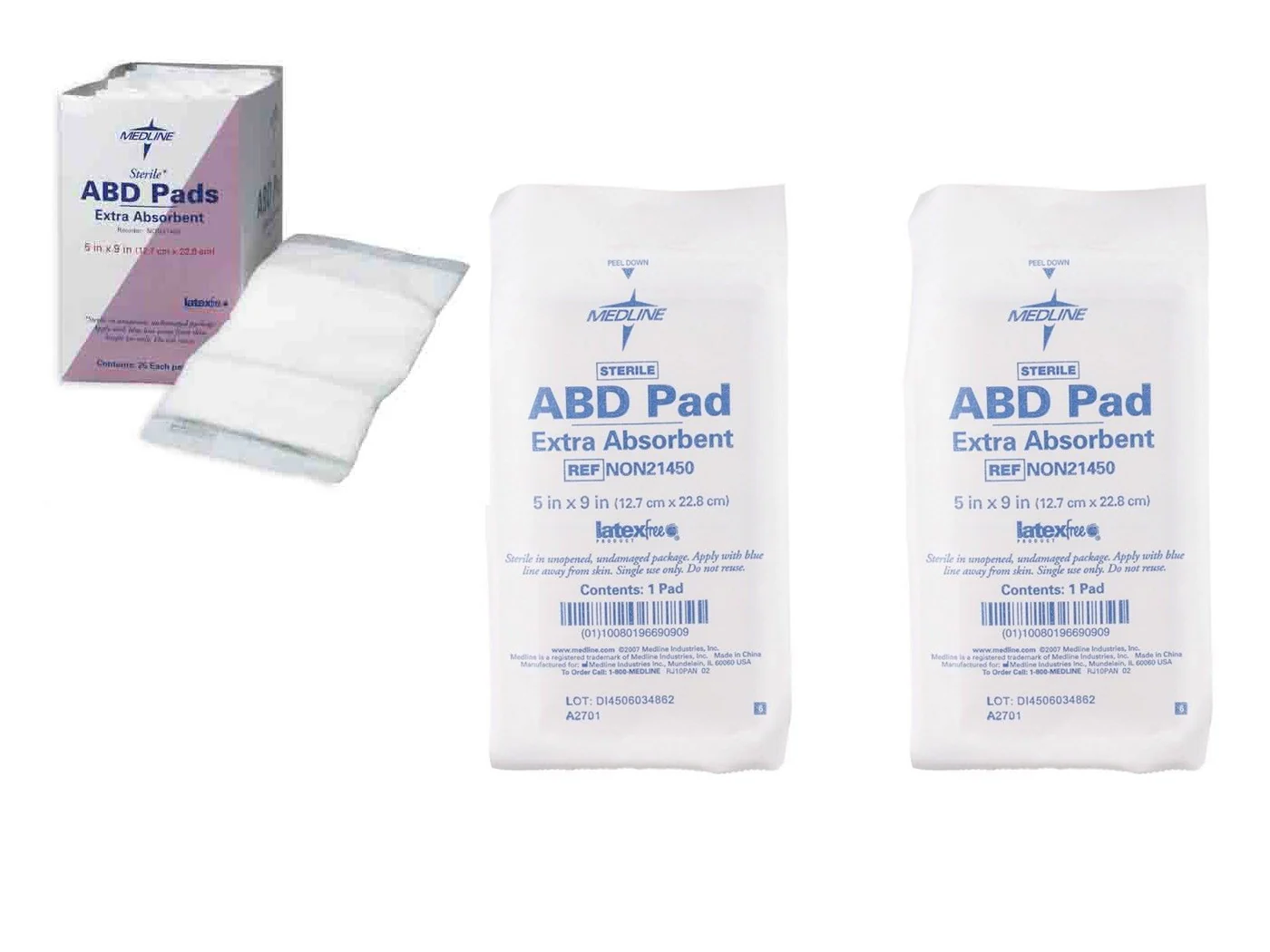
The name on the box is the first thing that misleads buyers. "ABD" does not tell you where the pad goes or how much fluid it holds, and it is not a clue that this is an abdomen-only product. An ABD pad is a high-capacity absorbent dressing, and choosing one well is a drainage-capacity decision: how much exudate the wound makes, whether the pad is the primary or secondary layer, sterile or non-sterile, and what size actually covers the wound. Pick by body part or by "thickest pad wins" and you either macerate skin or waste money. This guide is for the people ordering these in volume, materials managers, charge nurses, and procurement staff in hospitals, surgery centers, long-term care, and clinics.
ABD Pad, Combine Pad, "Army Battle Dressing": What the Name Tells You (and Doesn't)
Start with the vocabulary, because catalogs use several names for one product. An ABD pad and a combine pad are the same thing: a large, thick, multi-layer absorbent dressing. Distributors list it as an "ABD pad," "abdominal pad," "combine pad," or "combine ABD," and the terms are used interchangeably across brands like Medline, Cardinal Health Curity, Dynarex, and Dukal.
The acronym itself is a common source of confusion. Many clinicians read "ABD" as "abdominal," but the term originates from military use: one large distributor notes that ABD stands for "Army Battle Dressing," the dressing was originally developed for the military to treat battle wounds, and many caregivers today wrongly associate it as an abdominal-only dressing when its actual purpose is to manage heavy-draining or large wounds. Both readings circulate, so the practical takeaway matters more than the etymology: the name does not dictate the body part. An ABD pad is used wherever drainage is heavy, including large abdominal incisions and trauma, but also pressure injuries, post-surgical sites, and limb wounds.
So treat "ABD," "abdominal pad," and "combine pad" as synonyms when you compare products, and ignore the implication that the pad belongs on a belly. What you are really buying is absorbent capacity.
What an ABD Pad Is Made Of and How It Works
The construction is what separates an ABD pad from a flat gauze sponge. It is a two-part dressing: an inner core of fluffed cellulose or layered cotton, wrapped in a soft non-woven outer cover. As one supplier's how-to describes it, the outer layer fully covers the inner core and has its ends sealed with a moisture-resistant material so it resembles a candy wrapper, wicking fluid away from the wound and into the core while the sealed ends help stop seepage. Most pads add a hydrophobic backing on one face so fluid does not strike through to bedding, gloves, or outer wraps. The distributor category page describes the same design: a thick absorbent layer that disperses fluid to keep it from pooling on the wound, with sealed edges and a back designed to prevent strike-through.
That backing is also why orientation matters. The absorbent non-woven face goes against the wound; the moisture-resistant backing faces out. Put it on backwards and the barrier traps fluid against the skin instead of wicking it away.
An ABD pad has no adhesive, so it is not self-securing. It is held in place with tape, a roll bandage, or a wrap, and it works as either a primary dressing placed directly on the wound or a secondary dressing layered over a non-adherent contact layer or packing.
ABD Pad vs Gauze vs Alginate or Foam: When a Combine Pad Is the Right Tool
The honest version of this section is the one the category pages skip: an ABD pad is not always the right dressing, and reaching for the thickest pad by reflex can be the wrong call.
Plain gauze sponges are thin and non-occlusive. They are cheap and useful, but per StatPearls they are not moisture-retentive, can perform non-selective debridement that strips new granulation tissue at each change, and usually require a secondary dressing. An ABD pad is the high-capacity secondary layer those wounds often need, or a primary cover when drainage is heavy and the wound bed is intact enough to tolerate it. If you are reaching for a stack of folded 4x4 gauze to soak up drainage, one ABD pad usually does the job with fewer pieces and less strike-through.
But heavy exudate alone does not always mean "ABD pad." The same StatPearls review notes that moderate-to-heavy exudate is managed with foams, hydrocolloids, or alginates, while films and hydrogels are contraindicated for heavy or infected wounds because they are non-absorbent or low-absorbency. An ABD pad is a passive absorbent cover; it does not interact with the wound bed the way an alginate or foam does. For a deep cavity, packing plus an absorbent cover is the pattern, and for a heavily exuding chronic wound a foam or alginate as the contact layer, topped by an ABD pad, often outperforms an ABD pad alone. For our deeper comparison of contact-layer options, see the wound dressing selection guide and the breakdown of types of wound dressings. For deep cavities specifically, negative pressure wound therapy is often the better long-term tool than repeated bulky dressings.
Match the Pad to the Drainage, Not the Body Part
This is the decision that should drive the order. Exudate volume, not anatomy, tells you whether an ABD pad belongs on the wound and how big it needs to be.
Why it matters clinically: getting capacity wrong cuts both ways. Under-absorb and fluid sits against the periwound skin. StatPearls is explicit that a wound bed rich in exudate can hinder healing, so selecting a dressing that controls exudate is critical to avoid maceration of the surrounding tissue. Over-absorb, and you have bought a sterile 8x10 pad for a job a non-sterile 5x9 would have done, multiplied across thousands of dressing changes. A quick field guide:
- Light drainage: an ABD pad is usually overkill. A simple gauze pad or a thin foam/film is enough; reserve combine pads for when fluid volume justifies the bulk.
- Moderate drainage: a 5x9 ABD pad as a primary or secondary cover is the common workhorse.
- Heavy drainage or large surface area: step up to 8x10, or a multi-trauma pad (for example 10x30) for large incisions and trauma.
- Deep or undermined wounds: pack first, then use the ABD pad as the absorbent secondary cover. The pad does not replace packing.
Change frequency follows saturation, not the clock. Plan to change when the pad approaches capacity rather than on a fixed schedule alone, and re-assess the wound at each change. If you are sizing the dressing plan around drainage levels, our guide to the types of wound drainage walks through serous, sanguineous, and purulent exudate and what each implies for absorbency.
ABD Pad Sizes and How to Choose
Sizes are quoted as flat pad dimensions. The two you will order most are 5x9 inches and 8x10 inches, with larger multi-trauma formats such as 10x30 for major incisions and field trauma. Thickness, or ply, also varies between products, which affects capacity independent of footprint.
The sizing rule is coverage with margin: the pad should cover the wound and extend onto intact periwound skin so fluid is captured beyond the wound edge, not just over it. For a primary cover that means a pad larger than the wound on every side; for a secondary layer it means a pad large enough to fully cover the underlying contact dressing or packing. Buying one size to cover everything is convenient but expensive, because the larger sterile pads cost meaningfully more per piece. Most facilities stock 5x9 as the default and 8x10 for larger or heavier wounds rather than defaulting to the biggest pad for all uses.
Sterile vs Non-Sterile: A Clinical Decision, Not a Name Choice
Both versions exist and both are legitimate products. The FDA classifies the non-resorbable gauze/sponge for external use, the category that covers ABD pads, as a Class I device that is "a sterile or nonsterile device intended... to be placed directly on a patient's wound to absorb exudate," exempt from premarket notification. In other words, "sterile" is not a quality grade; it is a packaging-and-processing choice, and the regulation explicitly recognizes both.
Which to buy is a clinical and protocol decision, not a regulatory mandate and not something the product name decides. The general pattern facilities follow: use sterile pads for open or surgical wounds and any situation handled with aseptic technique, and reserve non-sterile pads for intact skin, padding, splint cushioning, drainage cleanup, and other non-wound uses. Follow your facility's wound-care policy and the manufacturer's instructions for the specific product rather than a blanket rule. For procurement, the practical consequences are two: sterile pads cost more per piece and have a defined shelf life and packaging integrity to track, so do not over-buy sterile stock for jobs that intact-skin non-sterile pads can do, and do confirm packaging integrity at receiving and before use, because a compromised sterile barrier is a survey and audit finding.
Buying and Procurement Checklist
Once you have settled drainage level, size, and sterility, the remaining decisions are about cost, compliance, and consistency across the order:
- Absorbency and ply. Compare core thickness and stated capacity, not just footprint. A thicker 5x9 can out-absorb a thin 8x10.
- Backing and edge seal. Confirm a moisture-resistant backing and fully sealed edges to limit strike-through and linting into the wound.
- Latex-free. Most facility formularies require latex-free; verify it on the spec sheet rather than assuming.
- Sterile shelf life and packaging. For sterile stock, track expiration and inspect the barrier at receiving and point of use.
- Case quantity and cost-per-pad. Normalize pricing to cost per pad across box and case quantities; the relevant number is cost per dressing change, not the sticker price of a box.
- Standardize sizes. Stocking two sizes (a 5x9 default and an 8x10 step-up) keeps par levels simple and reduces the chance staff grab a sterile pad for a non-sterile job.
Cost deserves the last word, because it is where over-buying hides. StatPearls frames wound-care cost as a comprehensive measure of the cost of care and patient outcome, not just the price of the individual dressing, with chronic wounds contributing more than $25 billion in annual treatment cost in the United States. For a consumable bought by the case, the right ABD pad is the one that controls the drainage in the fewest changes at the lowest cost per change, sized and sterilized to the job rather than to the worst case. ABD pads sit alongside gauze, tapes, and contact layers in a facility's standing order; our overview of wound care supplies and the gauze pads buying guide cover the neighboring line items. iMedSales stocks combine pads from recognized brands and offers a price-match guarantee, but the buying logic above applies wherever you source them.
Frequently Asked Questions
What does ABD stand for?
It is most often traced to "Army Battle Dressing," reflecting the pad's military origin, though many clinicians read it as "abdominal." A major distributor states plainly that ABD stands for "Army Battle Dressing" and that the abdominal association is a common misconception. Either way, the name does not limit the pad to the abdomen; it is used wherever drainage is heavy.
Are ABD pads and combine pads the same thing?
Yes. "ABD pad," "abdominal pad," and "combine pad" all describe the same large, multi-layer absorbent dressing. The supplier how-to that explains combine-pad construction notes that many people simply call combine pads "ABD pads". Compare them as one product across brands.
Which side of an ABD pad faces the wound?
The soft, absorbent non-woven face goes against the wound, and the moisture-resistant backing faces away from it. Because the pad is built with a back designed to prevent strike-through, applying it backwards traps fluid against the skin instead of wicking it into the core. If a pad has a printed or colored backing, that side faces out.
Can you put an ABD pad directly on an open wound?
Yes. An ABD pad can serve as a primary dressing placed directly on the wound or as a secondary cover over a contact layer or packing, and the supplier guidance confirms it is used as either a primary or secondary dressing and secured with tape or a wrap since it has no adhesive. For an open or surgical wound, use a sterile pad and follow your facility's aseptic protocol.
What size ABD pad do I need?
Choose by coverage with margin: the pad should cover the wound or the underlying dressing and extend onto intact periwound skin. A 5x9 inch pad handles most moderate wounds, 8x10 suits larger or heavier-draining wounds, and multi-trauma sizes like 10x30 are for large incisions and trauma. Sizing too small lets fluid escape at the edges; defaulting to the largest sterile pad for every job wastes money.